
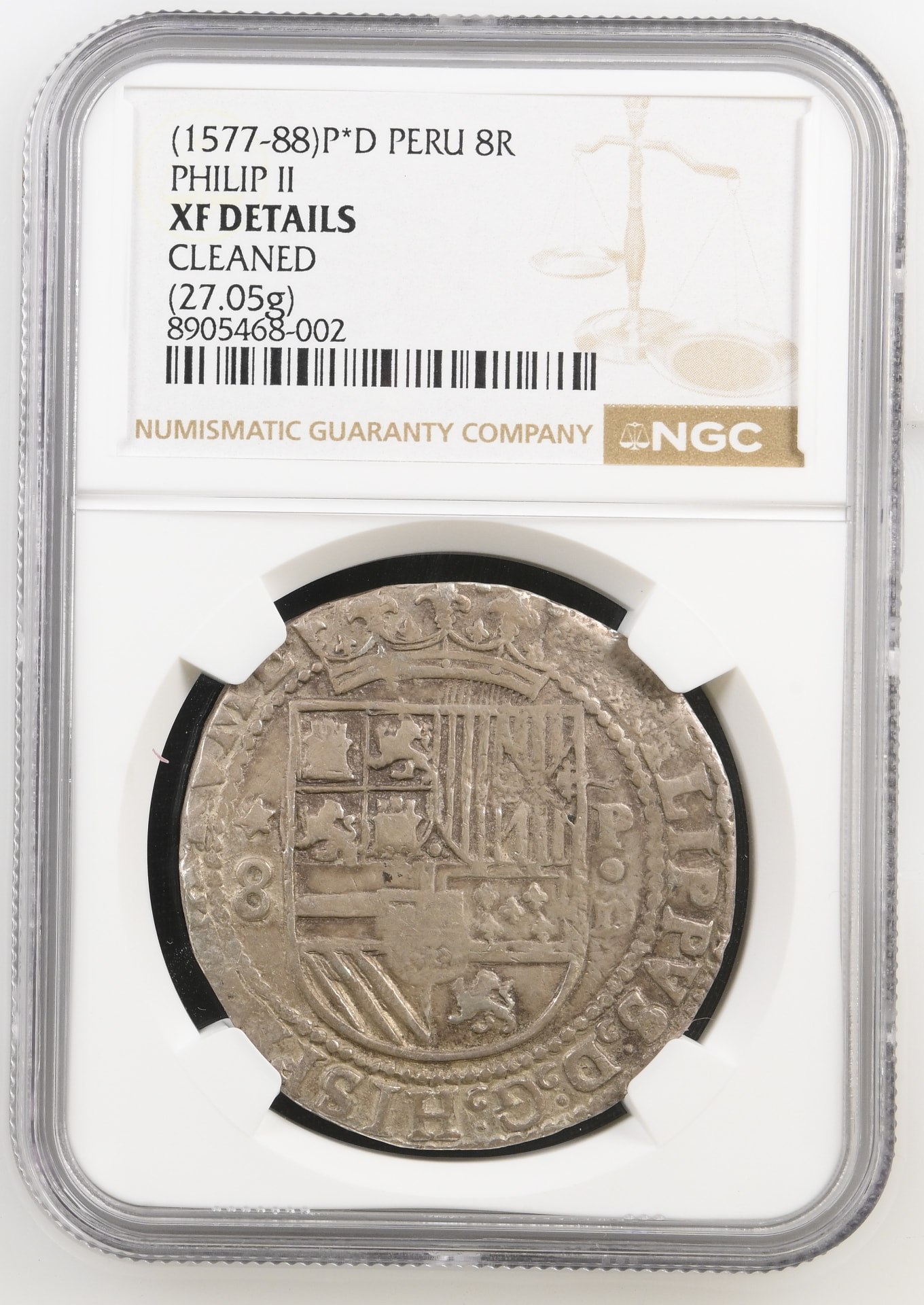
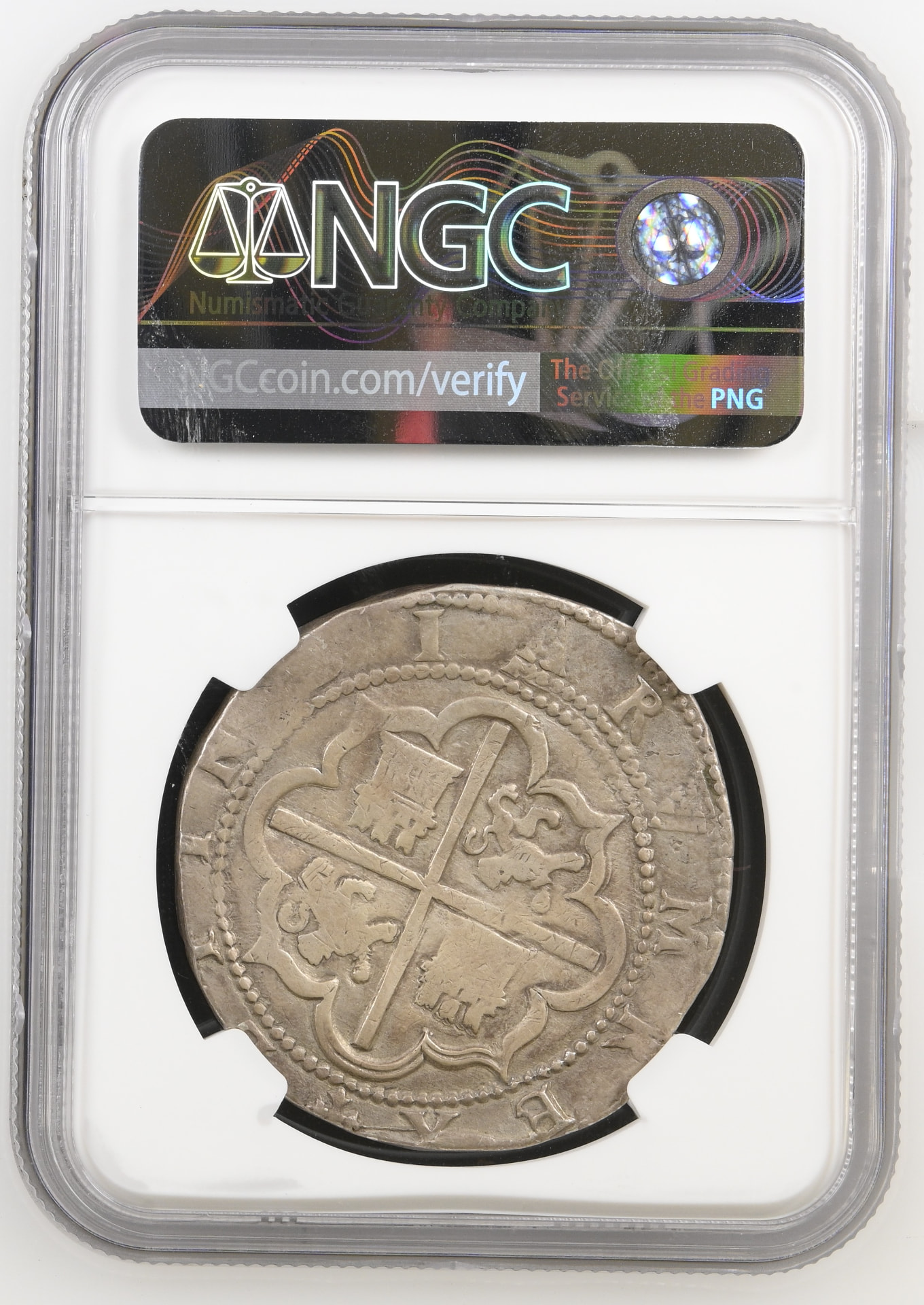
(1577-88) 8 Reales
A full-weight Philip II shield-type eight reales from Potosí - the coin that carried the silver of Cerro Rico into the world economy.
- Metal
- Silver
- Mint
- Potosí (P*D)
- Grade
- NGC XF Details · Cleaned · 27.05 g
- Cert #
- 8905468-002
Full attribution & era
The history behind the coin.
This is the archetypal piece of eight: a Philip II shield-type eight reales struck at Potosí, in what is now Bolivia but was then the silver heart of the Viceroyalty of Peru. The mintmark and assayer appear together as P*D at the left of the shield, with the denomination 8 opposite, placing it in the 1577-88 window of Potosí's early production.
Potosí exists because of one mountain. In 1545 an indigenous prospector found silver on the Cerro Rico, and within a generation a town at 13,000 feet became one of the largest cities in the world, larger than London or Seville at its peak. The mint was established in 1572 under Viceroy Francisco de Toledo, the same administrator who imposed the mita labor draft that fed the mines and refineries. Every one of these coins is a product of that system - and of the mercury amalgamation process that turned Andean ore into fine silver bars ready for the assayer.
The design is deliberately austere. The obverse carries the crowned Habsburg shield of Philip II, quartering the castles of Castile, the lions of León, the pales of Aragón, the chains of Navarre, the lilies of the Bourbon-Sicilian quarters and the pomegranate of Granada, surrounded by PHILIPVS II D G HISPANIARVM. The reverse shows the cross potent of Jerusalem within a quatrefoil tressure, with castles and lions in the angles - the "cross and lions" reverse that generations of sailors, merchants and pirates would recognise on sight.
Coins like this are the direct ancestors of the world's first global currency. Potosí eight reales moved by mule to Arica or Lima, north to Panama, across the Atlantic in the treasure fleets, and onward from Seville to Amsterdam, the Levant and - via Manila - to Ming China, where Spanish silver underwrote an entire monetary system. They also sank by the ton, which is why so many survivors today are sea-salvaged rather than land finds.
This example is a heavy, well-centered coin at 27.05 grams - essentially full standard weight for the eight-reales denomination, which is uncommon for early Potosí output where clipping and irregular flans are the rule. NGC graded it XF Details, Cleaned: an old conservation, with the full shield, legends and cross remaining boldly struck and readable. For a collector who wants the real thing - a 16th-century Potosí dollar with strong detail rather than a worn stub - the "details" designation is the trade that makes it attainable.
- Sedwick, D. & F. - The Practical Book of Cobs (Potosí, Philip II shield type)
- Krause & Mishler, Standard Catalog of World Coins (Bolivia/Potosí, KM#5)
- NGC certification 8905468-002