
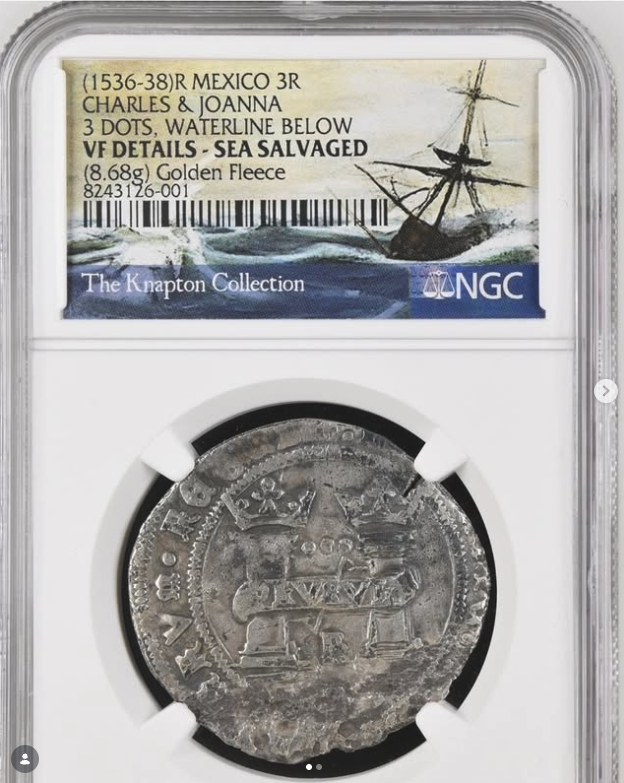
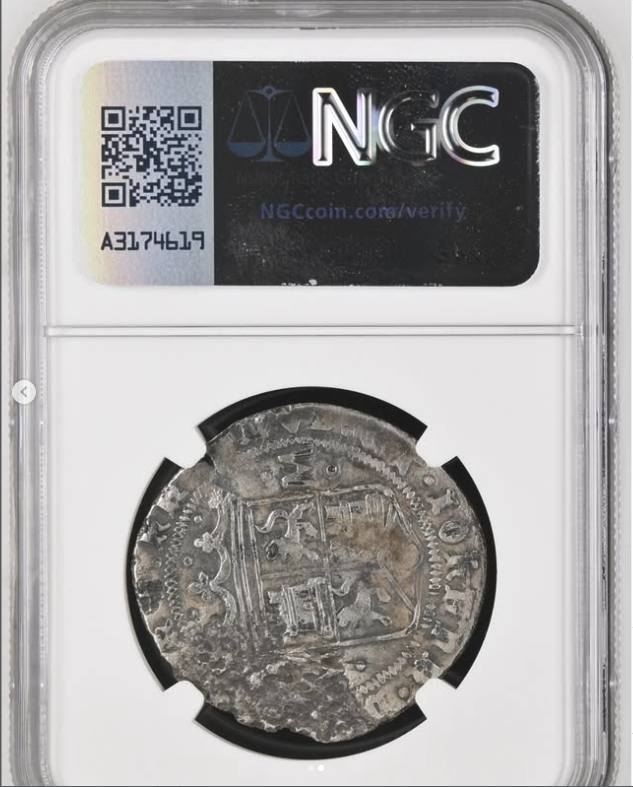
1536 3 Reales (Charles & Joanna)
Among the first coins ever struck in the New World - 1 of only 4 known of the 3 Dot / Water Below Pillars variety.
- Country
- Mexico (Spanish Colonial)
- Metal
- Silver
- Mint
- Mexico City (M), Assayer R
- NGC Grade
- VF Details · Sea Salvaged
How the coin reached the seabed.
Another crown jewel of The Knapton Collection - the most advanced esoteric shipwreck coin collection currently assembled. This coin is one of the FIRST EVER struck in the New World and is 1 of only 4 known of this variety.
In her article "Varieties of Rincón Three Reales of Mexico Charles-Joanna," Cori Sedwick conducted a die study and concluded that the 3 dot variety with water under pillars were the first coins struck in Mexico when the mint opened in 1536. By royal decree, 3 Reales were to be paid to each mint official for every mark of silver they coined. Nesmith states that the pay was actually 2 Reales; Sedwick theorizes that this discrepancy, on top of the unpopular design of the calm water below the pillars, were the reasons why this design and denomination were discontinued. A modified water-below-pillars design would return with the late series beginning in 1542.
The 4 examples of the 3 Dot / Water Below variety are: the Rudman Specimen (NGC VF-30); the Nesmith/Karon/Elizondo/Angert Specimen (NGC VF Holed, Tooled); the Knapton Specimen (NGC VF Sea Salvaged); and the Banco de Mexico Specimen (Unknown Condition).
The Golden Fleece Shipwreck was a Spanish Nao that sank around 1555 carrying many gold finger bars stamped with the Royal tax mark of a Golden Fleece (hence the name), tumbaga bars, and a relatively small amount of coins compared to later treasure galleons. The Golden Fleece contained many extreme rarities of early Mexican numismatics - including all 3 known 1538 Mexico Early Series 8 Reales, and this coin.
- Sedwick, Cori. "Varieties of Rincón Three Reales of Mexico Charles-Joanna."
- Nesmith, Robert I. The Coinage of the First Mint of the Americas at Mexico City, 1536-1572.